Bow Mount vs Stern Mount Spot-Lock Trolling Motor for Kayaks
Bow Mount vs Stern Mount Spot-Lock Trolling Motor for Kayaks
the bow or the stern.
Both mounting positions can work well, but they behave differently on the water.
Bow mounting can provide excellent directional control, while stern mounting may offer a simpler and more compact installation on many kayaks.
In this guide, we’ll compare bow mount vs stern mount Spot-Lock trolling motors and explain which setup may be better for different types of kayak fishing.
What Is a Bow Mount Trolling Motor?
A bow-mounted trolling motor is installed near the front of the kayak.
When operating, the motor effectively pulls the kayak through the water.
Bow mounting is common on larger fishing boats and has become increasingly popular on advanced fishing kayaks.
It is especially useful with:
- GPS position holding
- Spot-Lock
- Heading control
- Remote steering
- Automatic positioning
What Is a Stern Mount Trolling Motor?
A stern-mounted trolling motor is installed at the rear of the kayak.
Instead of pulling the kayak from the front, the motor pushes it from the rear.
Stern mounting is popular because many kayaks already have space at the rear for:
- Rudder systems
- Motor mounts
- Accessory plates
- Transom-style brackets
For some kayaks, stern mounting can be easier and require fewer modifications.
Bow Mount vs Stern Mount: Quick Comparison
| Feature | Bow Mount | Stern Mount |
|---|---|---|
| Motor Position | Front of kayak | Rear of kayak |
| Propulsion Style | Pulls kayak | Pushes kayak |
| Spot-Lock Control | Excellent in many conditions | Can also work effectively |
| Installation | May require adaptor | Often easier on compatible kayaks |
| Deck Space | Uses bow area | Uses stern area |
| Fishing Access | Can affect bow storage | Keeps bow area open |
Why Bow Mounting Is Popular for Spot-Lock
Bow mounting is popular because pulling a kayak can provide controlled directional response.
When wind or current pushes the kayak away from the selected GPS point, the motor can pull the bow back toward the target.
This can provide smooth corrections in many fishing situations.
Bow mounting can be especially useful for:
- Open-water fishing
- Offshore structure
- Windy lakes
- Vertical jigging
- Precise GPS positioning
Advantages of a Bow Mount Spot-Lock Motor
1. Strong Directional Control
Because the motor pulls the kayak from the front, steering corrections can feel natural and controlled.
2. Excellent for GPS Position Holding
Bow-mounted GPS trolling motors are widely used for automatic positioning because the motor can pull the boat toward the selected location.
3. Good for Windy Conditions
In many situations, the bow can be actively controlled into the wind while the motor maintains position.
4. Useful for Casting
Controlled boat orientation can help anglers maintain a consistent casting angle toward structure or shoreline.
Disadvantages of Bow Mounting
1. Installation Can Be More Complicated
Many kayaks do not have a factory trolling motor mount at the bow.
A dedicated mounting adaptor may be required.
2. Uses Bow Storage Space
The motor and mounting plate may interfere with:
- Bow hatches
- Storage access
- Handle access
- Fish finder equipment
3. Loading and Transport
A front-mounted motor can make it more difficult to lift or transport the kayak unless the motor is easily removable.
Advantages of a Stern Mount Spot-Lock Motor
1. Easier Installation on Many Kayaks
Many fishing kayaks already have a reinforced rear area for a rudder, motor bracket, or accessory plate.
This can make stern installation much easier.
2. Keeps the Bow Clear
A stern-mounted motor leaves the front of the kayak available for:
- Storage
- Fish finder equipment
- Landing fish
- Mounting accessories
3. Familiar Propulsion Layout
Rear-mounted propulsion is similar to the layout used on many small boats.
The motor pushes the kayak forward from the stern.
4. Good for Portable Setups
Depending on the mounting system, a stern-mounted motor can be easy to remove after fishing.
Disadvantages of Stern Mounting
1. Different Position-Holding Behavior
Because the motor pushes from behind, the kayak may respond differently to wind and current compared with a bow-mounted setup.
Motor control software and steering design become especially important.
2. Rear Access
The motor can take up space around:
- Rudder hardware
- Rear storage areas
- Crate systems
- Power cables
Does Spot-Lock Work from the Stern?
Yes, a GPS position-holding motor can work from the stern when the system is designed and configured for rear installation.
The control system must understand the motor’s mounting orientation and steering response.
When properly configured, the motor can automatically adjust steering and thrust to help keep the kayak near the selected GPS position.
Bow Mount vs Stern Mount in Wind
Wind strongly affects lightweight kayaks.
A bow-mounted motor can pull the kayak into position and may provide strong control over the front of the kayak.
A stern-mounted motor pushes from behind and may behave differently depending on wind direction and kayak hull shape.
The better setup depends on:
- Kayak length
- Kayak width
- Wind direction
- Motor power
- Steering system
Bow Mount vs Stern Mount in Current
In current, both systems require enough available motor power to counter water movement.
Bow mounting may allow the kayak to be pulled directly into the current.
Stern mounting can also maintain position, but the kayak may orient differently depending on the control system and current direction.
Strong current increases battery consumption regardless of mounting location.
Which Mount Is Better for Offshore Fishing?
Bow mounting is often attractive for anglers who prioritize precision GPS positioning and boat orientation.
Offshore fishing commonly involves:
- Deep water
- Wind
- Vertical jigging
- Small underwater targets
- Frequent position corrections
However, a properly designed stern-mounted GPS system can also provide effective position holding.
Which Mount Is Better for Shallow-Water Fishing?
In calm shallow water, the difference may be less important.
Anglers may prioritize:
- Easy installation
- Motor clearance
- Ability to raise the motor quickly
- Access to storage
A stern mount may be especially convenient on kayaks with an existing rear motor or rudder mounting area.
Which Mount Is Better for Launching?
Launching a kayak with a motor installed requires attention to propeller and shaft clearance.
A motor should not drag on:
- Boat ramps
- Sand
- Rocks
- Shallow shoreline areas
A quick-release or lift-up mounting system can make launching easier regardless of whether the motor is installed at the bow or stern.
Which Mount Is Better for Transport?
For most kayak owners, a removable motor system is preferable.
This allows the motor to be removed before:
- Roof-rack transport
- Truck-bed transport
- Trailer transport
- Storage
The mounting base can remain on the kayak while the motor itself is removed.
What Is Heading Control?
Heading control helps maintain the direction the kayak is facing.
This is different from Spot-Lock.
Spot-Lock focuses on maintaining a GPS position, while heading control focuses on orientation.
Combining both functions can provide more precise fishing control.
Does Mounting Position Affect Heading Control?
Yes.
The motor’s location changes how steering inputs affect the kayak.
A front motor pulls the bow in the direction of steering, while a rear motor pushes the stern and changes the kayak’s heading from behind.
A GPS trolling motor designed for multiple mounting positions should account for these differences.
Battery Placement with a Bow Mount
If the motor is mounted at the front, the battery does not necessarily need to be installed next to the motor.
Battery placement should focus on:
- Weight distribution
- Wire length
- Water protection
- Accessibility
Heavy batteries should generally be positioned low and securely within the kayak.
Battery Placement with a Stern Mount
Rear-mounted motors are sometimes paired with batteries stored behind the seat.
However, too much weight in the stern can cause the kayak to sit excessively low at the rear.
Always consider total weight distribution.
Can the Same GPS Motor Be Used at the Bow and Stern?
Some GPS trolling motor systems are designed specifically for one mounting position, while others can support multiple configurations.
A motor designed for both positions may require:
- Different mounting adaptors
- Orientation settings
- Steering calibration
- Software configuration
Always follow the motor manufacturer’s installation instructions.
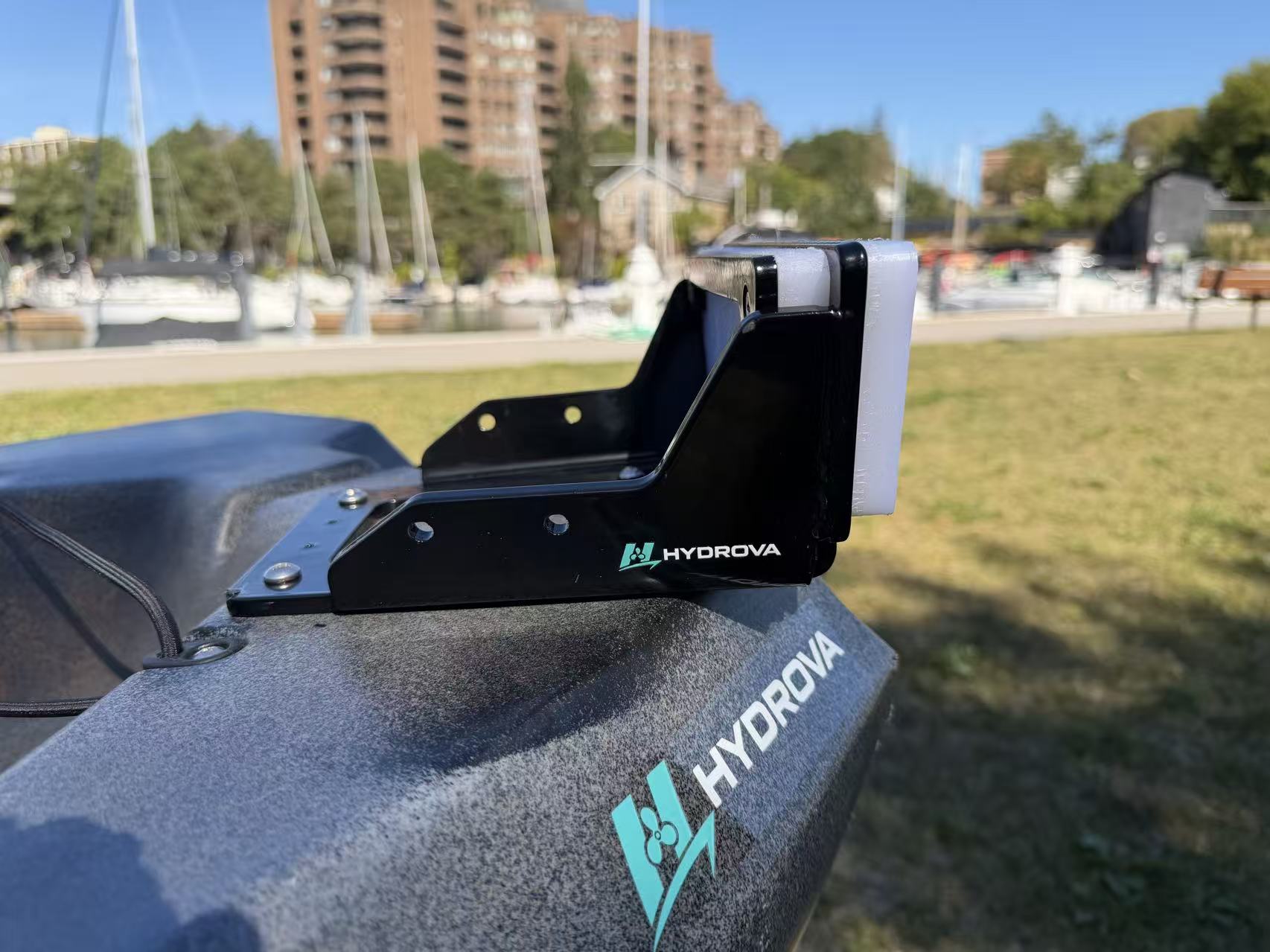
Hydrova Travel GPS Spot-Lock Trolling Motor
The Hydrova Travel GPS Spot-Lock Trolling Motor is designed to provide advanced GPS positioning for kayaks and small boats.
Its flexible installation concept allows it to be used in different mounting configurations depending on the watercraft and adaptor.
For compatible setups, the system can support:
- Bow-mounted kayak applications
- Stern-mounted kayak applications
- GPS position holding
- Remote steering
- Electric propulsion
A dedicated mounting adaptor may be required for bow installation depending on the kayak.
When Should You Choose a Bow Mount?
A bow mount may make sense if you prioritize:
- Precise GPS boat control
- Open-water fishing
- Offshore structure fishing
- Heading control
- Active positioning in wind
When Should You Choose a Stern Mount?
A stern mount may make sense if you prioritize:
- Simpler installation
- Keeping the bow clear
- Existing rear mounting points
- Portable propulsion
- Easy access to the motor mounting area
Can You Move a GPS Trolling Motor Between Kayaks?
A modular mounting system can make it possible to move the same motor between different compatible kayaks.
Each kayak may require its own mounting adaptor.
This can be useful for anglers who own more than one kayak or small boat.
Frequently Asked Questions
Is bow mount better than stern mount for Spot-Lock?
Bow mounting can provide excellent directional control and is widely used for GPS positioning, while stern mounting can offer simpler installation and can also work effectively when the motor system is designed for rear mounting.
Can Spot-Lock work from the back of a kayak?
Yes, if the GPS trolling motor supports stern mounting and is configured correctly.
Why are many trolling motors mounted at the bow?
Pulling the boat from the front can provide precise steering response and controlled positioning, which is especially useful for fishing.
Is stern mounting easier?
On many kayaks, yes. The stern may already have a rudder or motor mounting location that can simplify installation.
Do I need an adaptor for a bow-mounted kayak trolling motor?
Many kayaks require a dedicated bow mounting adaptor or reinforced mounting plate.
Can one trolling motor work in both positions?
It depends on the motor design. Some systems can support both bow and stern installations when used with the correct hardware and configuration.
Final Thoughts
Both bow and stern mounting can work well for a GPS Spot-Lock trolling motor.
A bow-mounted system can provide:
- Strong directional control
- Excellent GPS positioning
- Good performance in wind
- Useful heading control
A stern-mounted system can provide:
- Simpler installation
- Open bow space
- Compatibility with existing rear mounting areas
- A familiar rear-propulsion layout
The right choice depends on your kayak, fishing style, mounting hardware, and how you want the kayak to behave on the water.
For many anglers, the most valuable system is one that provides flexible installation options rather than forcing every kayak into the same configuration.
Explore Hydrova GPS Trolling Motors
GPS position holding and electric propulsion designed for flexible kayak and small-boat installations.
Bow or Stern. Hold Your Position. Focus on Fishing.