What Is Spot-Lock on a Trolling Motor? How GPS Position Holding Works for Kayaks
hat Is Spot-Lock on a Trolling Motor? How GPS Position Holding Works for Kayaks
Instead of dropping a physical anchor, a GPS trolling motor can automatically adjust steering and motor power to help keep your kayak or small boat near a selected position.
For kayak anglers, this can make fishing much easier in wind, current, and open water.
In this guide, we’ll explain what Spot-Lock is, how GPS position holding works, when it is useful, and what to look for when choosing a GPS trolling motor for a kayak.
What Is Spot-Lock?
Spot-Lock is a GPS-based position-holding feature used on trolling motors.
When you activate Spot-Lock, the trolling motor records your current GPS position.
The motor then automatically adjusts:
- Motor direction
- Motor speed
- Steering angle
to help keep the kayak or boat near that position.
This allows you to focus more on fishing instead of constantly correcting your position.
How Does Spot-Lock Work?
A GPS trolling motor uses positioning data to determine whether the boat is drifting away from the selected location.
If wind or current moves the kayak away from the target position, the motor automatically applies thrust and steering corrections.
The system continuously repeats this process while Spot-Lock is active.
In simple terms:
GPS detects movement → controller calculates correction → motor steers and applies power → kayak moves back toward the selected position.
Why Is Spot-Lock Useful for Kayak Fishing?
Kayaks are lightweight and can drift very easily.
Even moderate wind or current can move a fishing kayak away from a productive fishing location.
Without GPS position holding, the angler may need to constantly:
- Paddle
- Use a pedal drive
- Adjust the trolling motor manually
- Drop and retrieve an anchor
Spot-Lock can reduce this work and allow the angler to spend more time fishing.
Spot-Lock vs Traditional Anchor
Traditional anchors and GPS position holding perform a similar basic job: helping keep the boat in one area.
However, they work very differently.
| Feature | GPS Spot-Lock | Traditional Anchor |
|---|---|---|
| Deployment | Activated electronically | Anchor must be dropped manually |
| Retrieval | Instant electronic release | Anchor must be pulled up |
| Water Depth | Can work without contacting the bottom | Requires sufficient anchor line and bottom contact |
| Moving Locations | Fast | Requires retrieving and redeploying anchor |
| Battery Use | Uses electrical power | No electrical power required |
A physical anchor can still be useful, but GPS position holding offers much more convenience when moving frequently between fishing spots.
Where Is Spot-Lock Most Useful?
Fishing Offshore Structure
If fish are holding near a rock pile, drop-off, submerged tree, or other underwater structure, Spot-Lock can help keep the kayak close to the target area.
Fishing in Wind
Wind can push a kayak away from a fishing location very quickly.
GPS position holding can automatically compensate for this movement.
Fishing in Current
River and tidal current can make position control difficult.
A GPS trolling motor can continuously apply thrust to help counter the current.
Vertical Fishing
Spot-Lock can be useful when jigging vertically over a specific depth or underwater feature.
Fishing Drop-Offs
A drop-off may only be productive within a relatively small area.
Position holding can make it easier to stay close to the productive depth.
Is Spot-Lock Good for Kayaks?
Yes. GPS position holding can be especially useful on kayaks because kayaks are much lighter than traditional boats.
A light kayak can move quickly in:
- Wind
- Current
- Boat wake
- Changing water conditions
Automatic motor control can help reduce the amount of manual correction required.
Do You Need Spot-Lock on a Fishing Kayak?
Not every kayak angler needs GPS position holding.
A simple electric kayak motor may be enough if you mainly fish:
- Small ponds
- Protected lakes
- Calm water
- Near shore
Spot-Lock becomes much more valuable if you frequently fish:
- Large lakes
- Open water
- Strong current
- Windy areas
- Offshore structure
How Accurate Is Spot-Lock?
GPS position-holding accuracy depends on the motor system, GPS signal quality, wind, current, motor power, kayak weight, and installation.
The motor will normally move the kayak within a small area around the selected position rather than keeping it perfectly motionless.
Strong wind or current may require more frequent corrections.
Why Does a Kayak Move Around While Spot-Lock Is Active?
Spot-Lock does not physically lock the kayak to one exact point.
Instead, the system continuously corrects position.
This means the kayak may move slightly forward, backward, or sideways while the system responds to changing conditions.
The amount of movement depends on:
- GPS accuracy
- Motor response
- Wind speed
- Current
- Kayak weight
- Mounting location
Bow Mount vs Stern Mount for Spot-Lock
GPS trolling motors can be installed in different positions depending on the kayak design.
Bow Mount
Bow mounting is commonly used because the motor can pull the kayak toward the selected position.
Pulling from the front can provide controlled positioning in many fishing situations.
Stern Mount
A GPS trolling motor can also be used from the stern when the motor and control system are designed for that configuration.
Stern mounting may be easier on some kayaks because the rear of the kayak already has space for a motor mount or adaptor.
The best setup depends on the kayak, motor design, steering system, and fishing style.
What Is Heading Control?
Heading control is different from Spot-Lock.
Spot-Lock focuses on maintaining position.
Heading control focuses on maintaining the direction the kayak is facing.
For example, a GPS trolling motor may help keep the kayak pointed toward a shoreline, fishing structure, or target area while the angler casts.
Spot-Lock vs Heading Control
| Feature | Purpose |
|---|---|
| Spot-Lock | Helps maintain a GPS position |
| Heading Control | Helps maintain the direction the kayak is facing |
Advanced trolling motor systems may use both features to provide more precise boat control.
What Is a GPS Anchor?
GPS anchor is another term commonly used for GPS position-holding technology.
Instead of physically attaching the kayak to the lake or river bottom, the motor uses GPS information and automatic thrust to help maintain position.
The terms GPS anchor, position hold, and Spot-Lock are often used to describe similar functions, although exact terminology and operation may vary by manufacturer.
Does Spot-Lock Use a Lot of Battery?
Battery consumption depends heavily on conditions.
In calm water, the motor may only need occasional corrections.
In strong wind or current, the motor may operate much more frequently and at higher power.
Factors affecting battery use include:
- Wind speed
- Current
- Kayak weight
- Motor size
- Propeller efficiency
- Battery voltage
- How aggressively the system corrects position
Can Spot-Lock Replace an Anchor?
In many fishing situations, GPS position holding can reduce the need to deploy a traditional anchor.
However, it should not always be treated as a complete replacement for every anchoring situation.
A traditional anchor may still be useful when:
- Battery power is limited
- You want to remain stationary for a long period
- Conditions exceed the motor’s ability to hold position
- You need a backup positioning method
What Motor Power Is Needed for Spot-Lock?
The required motor power depends on:
- Kayak size
- Loaded weight
- Wind
- Current
- Water conditions
A heavier fishing kayak or stronger current may require more thrust than a lightweight kayak in calm water.
The motor should have enough available power to make effective corrections without operating at maximum output continuously.
Can You Add Spot-Lock to a Kayak?
Yes, if the kayak can support a compatible GPS trolling motor and mounting system.
Before installing one, check:
- Kayak weight capacity
- Mount strength
- Battery placement
- Motor clearance
- Propeller clearance
- Steering clearance
- Wiring
What to Look for in a Kayak Spot-Lock Trolling Motor
When choosing a GPS trolling motor for a kayak, consider:
- GPS position holding
- Remote steering
- Heading control
- Motor power
- Battery voltage
- Motor weight
- Mounting compatibility
- Water resistance
- Remote control design
- Battery consumption
Why Remote Control Matters
Remote control is especially useful on kayaks because space is limited.
A wireless remote can allow the angler to control:
- Steering
- Speed
- Spot-Lock
- Heading
- Motor start and stop
without reaching behind the seat or using a large tiller handle.
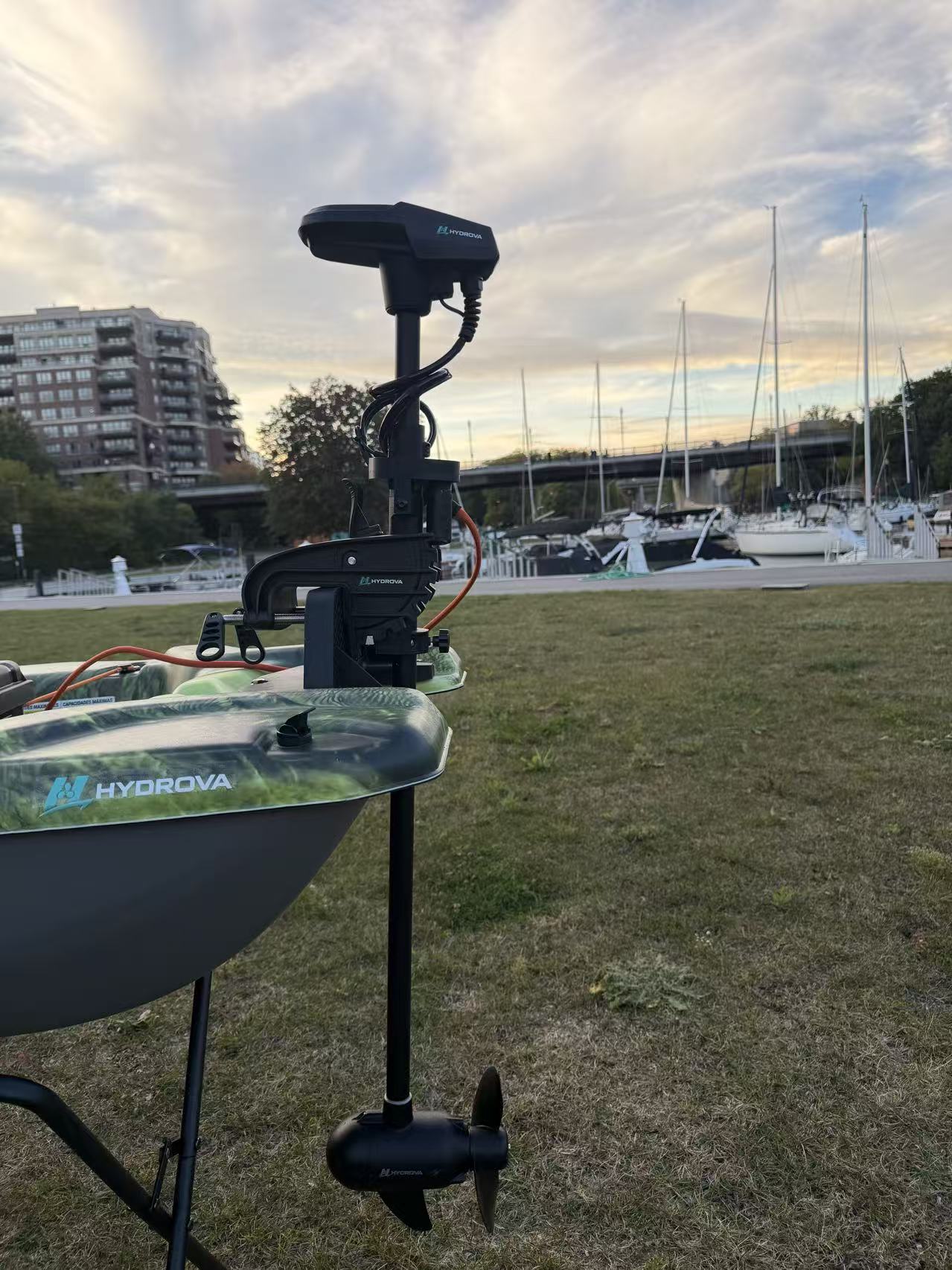
Hydrova Travel GPS Spot-Lock Trolling Motor
The Hydrova Travel GPS Spot-Lock Trolling Motor is designed for anglers who want advanced positioning and electric propulsion on kayaks and small boats.
It is designed to combine:
- GPS position holding
- Remote motor control
- Electric steering
- Kayak-friendly installation
- Portable small-boat applications
Depending on the kayak and mounting setup, the motor can be installed for different fishing configurations.
A mounting adaptor may be required depending on the kayak.
Who Should Consider a Spot-Lock Trolling Motor?
A GPS trolling motor may be especially useful for anglers who:
- Fish large lakes
- Fish open water
- Fish in wind
- Fish rivers or tidal areas
- Target offshore structure
- Fish vertically
- Frequently move between fishing spots
Frequently Asked Questions
What does Spot-Lock do on a trolling motor?
Spot-Lock uses GPS and automatic motor control to help keep the kayak or boat near a selected position.
Is Spot-Lock the same as an anchor?
It performs a similar positioning function, but it uses GPS and motor power instead of physically attaching the boat to the bottom.
Does Spot-Lock work on a kayak?
Yes. GPS position holding can work particularly well on fishing kayaks when the motor has sufficient power and is installed correctly.
Does Spot-Lock work in current?
Yes, but stronger current requires more motor power and can increase battery consumption.
Does Spot-Lock work in wind?
Yes. The motor can make automatic corrections as wind pushes the kayak away from the selected position.
Does Spot-Lock drain the battery?
It uses battery power whenever the motor needs to make corrections. Battery consumption increases in stronger wind and current.
Can Spot-Lock hold the kayak perfectly still?
Not exactly. The kayak may move within a small area as the motor continuously detects and corrects position.
Is Spot-Lock worth having on a fishing kayak?
It can be very useful for anglers who regularly fish in wind, current, open water, or over specific underwater structure.
Final Thoughts
Spot-Lock can dramatically change the way anglers control a fishing kayak.
Instead of constantly paddling, steering, or dropping an anchor, GPS position holding can automatically help keep the kayak near the fishing location.
The biggest advantages include:
- More time fishing
- Less manual position correction
- Better control in wind
- Better control in current
- Faster movement between fishing spots
- No need to repeatedly deploy an anchor
For serious kayak anglers, a GPS trolling motor can turn a basic motorized kayak into a much more capable fishing platform.
The ideal system combines:
GPS positioning + reliable steering + sufficient motor power + efficient battery use + kayak-friendly mounting.
Explore Hydrova GPS Trolling Motors
Advanced electric propulsion and GPS position holding designed for kayaks and small boats.
Hold Your Position. Focus on Fishing.