How Far Can an Electric Kayak Motor Go?
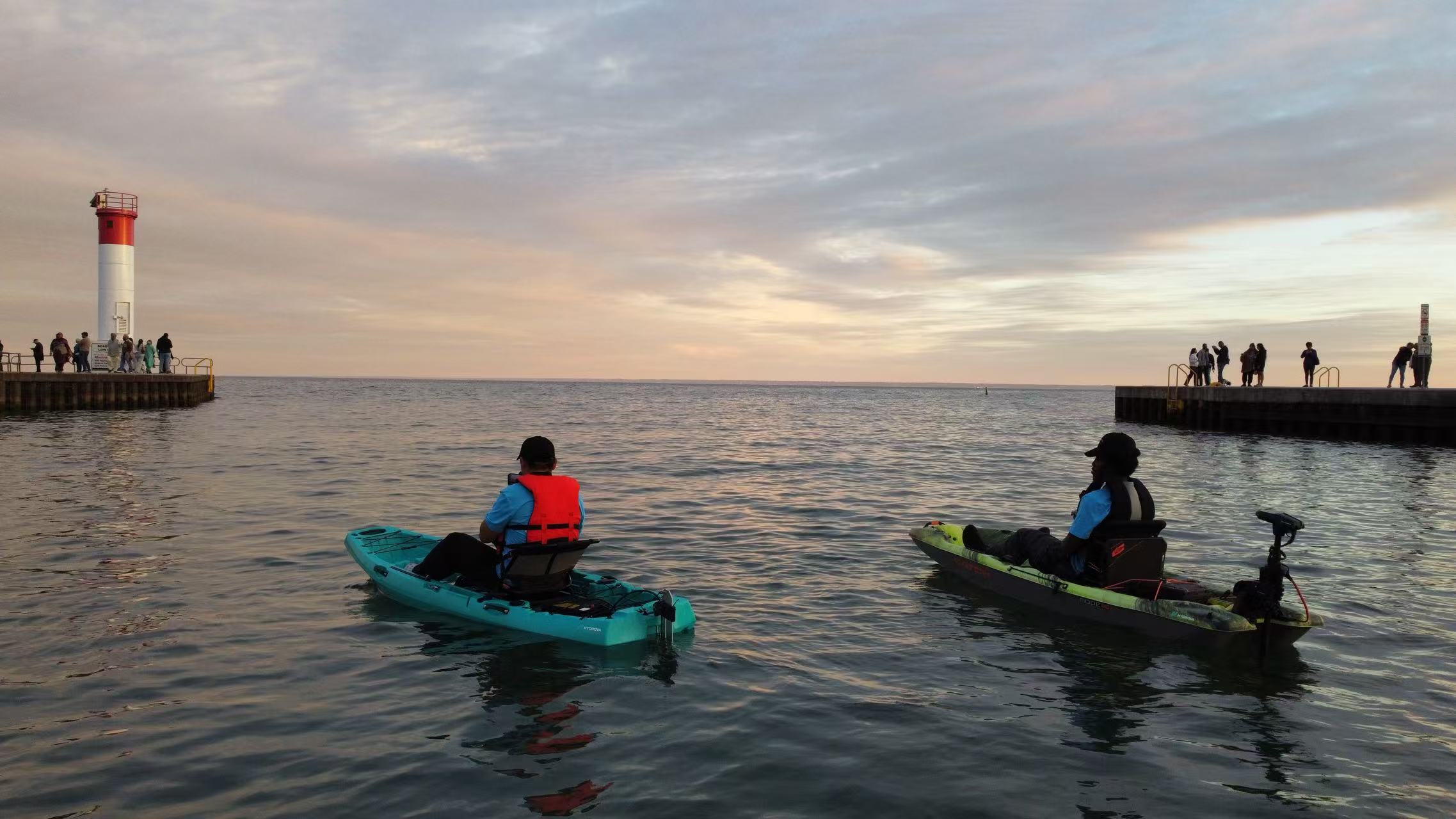
How Far Can an Electric Kayak Motor Go?
One of the most common questions kayak owners ask before buying an electric motor is:
How far can an electric kayak motor actually go?
The answer depends on several factors, including motor power, battery capacity, kayak weight, cruising speed, wind, current, hull design, and total load.
Some anglers only need enough range to move between nearby fishing spots, while others want to travel several miles from the launch point and spend an entire day on the water.
In this guide, we’ll explain how electric kayak motor range works, how to estimate your travel distance, and how battery size affects real-world performance.
How Far Can an Electric Kayak Motor Travel?
There is no single range number that applies to every electric kayak motor.
Real-world range depends on:
- Battery capacity
- Motor power
- Throttle level
- Kayak hull design
- Total weight
- Wind
- Water current
- Propeller efficiency
- Motor mounting position
In general, a kayak traveling at moderate cruising speed can cover significantly more distance than the same kayak running continuously at maximum throttle.
Range Depends on Battery Capacity
Battery capacity is one of the most important factors affecting kayak motor range.
Batteries are commonly rated in:
- Amp-hours (Ah)
- Watt-hours (Wh)
Watt-hours are useful because they represent the approximate amount of stored energy.
The formula is:
Voltage × Amp-Hours = Watt-Hours
Example: 24V 32Ah Battery
A 24V 32Ah battery has a theoretical capacity of:
24V × 32Ah = 768Wh
Example: 24V 58Ah Battery
A 24V 58Ah battery has a theoretical capacity of:
24V × 58Ah = 1,392Wh
A 58Ah battery therefore stores substantially more energy than a 32Ah battery at the same voltage.
Actual usable capacity can vary depending on battery chemistry, BMS settings, temperature, discharge limits, and battery condition.
How Long Can a 750W Kayak Motor Run?
A simple theoretical calculation can help explain runtime.
If a 750W motor continuously consumes its full 750W, a 24V 32Ah battery with approximately 768Wh of theoretical energy would provide:
768Wh ÷ 750W = approximately 1.02 hours
With a 24V 58Ah battery:
1,392Wh ÷ 750W = approximately 1.86 hours
These are theoretical full-power calculations only.
Real-world runtime may be different because the motor may consume less than maximum power while cruising.
Full Throttle vs Cruising Speed
Running at maximum speed requires much more energy than cruising at a moderate speed.
This is why kayak motor range can increase dramatically when you reduce throttle.
For example, an angler may use full power only when:
- Traveling between distant fishing spots
- Crossing open water
- Fighting stronger current
- Returning to the launch
During actual fishing, the motor may operate at much lower power.
Lower-speed use can include:
- Trolling
- Moving along shorelines
- Searching for fish
- Adjusting position
- Moving around structure
How to Estimate Kayak Motor Range
A simple range estimate is:
Average Speed × Runtime = Estimated Distance
Example 1
If your kayak travels at an average of 3 MPH for 4 hours:
3 MPH × 4 hours = 12 miles
Example 2
If your kayak travels at 2.5 MPH for 6 hours:
2.5 MPH × 6 hours = 15 miles
These examples are only simplified estimates.
Real-world range can change significantly depending on conditions.
Hydrova YAK-1 Speed
The Hydrova YAK-1 uses a 24V 750W electric propulsion platform.
Depending on the kayak and conditions, it can reach:
- Up to 5 MPH on regular rigid kayaks
- Up to 5.5 MPH on lightweight inflatable kayaks
Maximum speed is useful for traveling quickly, but lower cruising speeds can provide much better battery efficiency.
How Far Can the Hydrova YAK-1 Go?
The actual travel range of the Hydrova YAK-1 depends on battery size and how the motor is used.
A smaller battery provides a lighter and more portable setup, while a larger battery provides longer operating time.
For example:
- 24V 32Ah — lighter and more portable
- 24V 58Ah — designed for longer-range use
Actual distance will depend on cruising speed, water conditions, kayak weight, and how frequently full power is used.
Does a Bigger Battery Increase Range?
Yes.
Assuming the voltage is correct and both batteries can provide sufficient current, a larger-capacity battery usually increases runtime and therefore potential travel range.
For example, a 58Ah battery stores significantly more energy than a 32Ah battery at the same voltage.
However, a larger battery also adds:
- Weight
- Cost
- Physical size
The ideal battery should provide enough range without making the kayak unnecessarily heavy.
Does a Bigger Battery Make the Kayak Faster?
Usually not.
If both batteries provide the same voltage and sufficient current, the larger battery mainly increases runtime rather than top speed.
Maximum speed is influenced more by:
- Motor output
- Propeller design
- Hull shape
- Total weight
- Water conditions
How Kayak Hull Design Affects Range
Hull efficiency has a major effect on battery consumption.
A long, narrow kayak generally moves through the water more efficiently than a short, wide fishing kayak.
Fishing kayaks are usually designed for stability and may have:
- Wide hulls
- High seats
- Accessory rails
- Large storage areas
- Additional drag from fishing equipment
These features are useful for fishing but may reduce efficiency compared with a streamlined touring kayak.
How Weight Affects Electric Kayak Range
The heavier the kayak, the more energy may be required to accelerate and maintain speed.
Total loaded weight includes:
- Kayak
- Operator
- Battery
- Motor
- Fishing rods
- Fish finder
- Cooler
- Tackle
- Other accessories
Reducing unnecessary weight can improve overall efficiency.
How Wind Affects Range
Wind can significantly change electric kayak range.
A strong headwind increases aerodynamic and water resistance, which can force the motor to work harder.
This increases battery consumption and reduces range.
A tailwind can reduce the amount of power required to maintain speed.
How Current Affects Range
Current can have an even larger effect than wind.
Imagine your kayak can move at 5 MPH through the water.
Against a 2 MPH current, your GPS speed over the ground may only be approximately:
3 MPH
With the same current behind you, ground speed may increase significantly.
This is why river trips require careful battery planning.
Why the Return Trip Matters
One of the biggest mistakes electric kayak users can make is using too much battery on the outbound trip.
Conditions may be different when you return.
You may encounter:
- Stronger headwind
- Changing current
- Lower temperatures
- Additional cargo
- Rougher water
Always keep enough battery reserve to return safely.
How Much Battery Reserve Should You Keep?
It is generally a good idea not to plan a trip around using 100% of available battery capacity.
Keeping a reserve allows for unexpected changes in:
- Weather
- Current
- Route
- Battery performance
- Fishing location
Your actual safety reserve should depend on local conditions and how far you are traveling from shore or the launch.
Does Low-Speed Cruising Save Battery?
Yes.
Reducing speed can significantly reduce power consumption.
This can increase:
- Runtime
- Total range
- Fishing time
- Battery reserve
For long-distance trips, cruising efficiently is often more useful than operating continuously at maximum speed.
What Is the Most Efficient Speed for an Electric Kayak?
There is no universal most-efficient speed because every kayak has a different hull and load.
However, moderate cruising speeds are generally more efficient than maximum throttle.
The best strategy is to test your own kayak under realistic conditions and measure:
- GPS speed
- Battery percentage
- Time
- Distance traveled
This will give you a much more accurate estimate of your real-world range.
Rigid Kayak vs Inflatable Kayak Range
Rigid and inflatable kayaks can behave differently in the water.
Some lightweight inflatable kayaks may reach higher speeds because of their lower total weight.
The Hydrova YAK-1 can reach up to 5.5 MPH on lightweight inflatable kayaks under suitable conditions.
However, inflatable hull shape, pressure, width, and surface drag can all affect efficiency.
A rigid kayak may be heavier but can have a more hydrodynamically efficient hull.
How to Increase Electric Kayak Range
There are several ways to improve your range.
1. Reduce Cruising Speed
Moderate throttle can dramatically improve runtime compared with continuous maximum power.
2. Reduce Unnecessary Weight
Carry only the equipment you need.
3. Use a Larger Battery
More battery capacity generally means more available energy and longer range.
4. Improve Motor Alignment
Make sure the motor is installed straight and at the correct depth.
5. Keep the Propeller Clean
Weeds, fishing line, and debris wrapped around the propeller can reduce efficiency.
6. Plan Around Wind and Current
Check conditions before leaving and try to avoid using most of your battery while traveling with favorable conditions that may reverse later.
7. Keep the Battery in Good Condition
Proper charging and storage can help maintain battery performance.
Should You Carry a Spare Battery?
A spare battery can be useful for:
- Long-distance trips
- All-day fishing
- Remote areas
- Emergency backup
However, always consider the additional weight.
Make sure the combined weight of the operator, batteries, motor, and equipment remains within the kayak manufacturer’s rated capacity.
Can Solar Panels Extend Kayak Motor Range?
Small solar panels can sometimes help recharge batteries during long periods on the water, but they generally cannot provide enough power to continuously run a high-power kayak motor.
Solar charging is more useful as a supplemental charging source rather than a replacement for battery capacity.
How Far Should You Travel From the Launch?
The answer depends on your battery, water conditions, experience, and backup plan.
Before traveling far from the launch, consider:
- Remaining battery percentage
- Wind direction
- Current direction
- Weather forecast
- Distance back to shore
- Backup paddle
A paddle should always remain part of your safety equipment even when using an electric motor.
Hydrova YAK-1 for Long-Distance Kayak Fishing
The Hydrova YAK-1 is designed to provide portable electric propulsion for fishing and recreational kayaks.
Key features include:
- 24V electric platform
- 750W motor
- Up to 5 MPH on regular rigid kayaks
- Up to 5.5 MPH on lightweight inflatable kayaks
- Wireless remote control
- 4 forward speed levels
- 4 reverse speed levels
- Man-overboard detection
- Multiple mounting adaptor options
Users can choose battery capacity based on whether they prioritize portability or longer operating time.
Frequently Asked Questions
How many miles can an electric kayak motor go?
There is no fixed number. Range depends on battery capacity, average speed, motor efficiency, kayak weight, wind, current, and throttle level.
How long can a 750W motor run on a 24V 32Ah battery?
The theoretical full-power runtime is approximately one hour, but real-world runtime can be much longer when operating at lower power levels.
Will a 58Ah battery provide more range than a 32Ah battery?
Yes. At the same voltage, a 58Ah battery stores more energy and can generally provide longer runtime and greater potential range.
Does slower speed increase range?
Yes. Lower cruising speeds usually consume less power and can significantly extend battery runtime.
How fast is the Hydrova YAK-1?
The Hydrova YAK-1 can reach up to 5 MPH on regular rigid kayaks and up to 5.5 MPH on lightweight inflatable kayaks under suitable conditions.
Should I carry a paddle if I have an electric motor?
Yes. A paddle provides an important backup if you experience battery, motor, weather, or other unexpected issues.
Final Thoughts
Electric kayak motor range depends on much more than motor wattage.
The most important factors include:
- Battery capacity
- Average cruising speed
- Kayak efficiency
- Total load
- Wind
- Current
- Motor installation
If maximum range is your priority, cruising efficiently and selecting the right battery are usually more important than chasing maximum speed.
A properly matched electric propulsion system can allow kayak anglers to travel farther, reach more fishing locations, and spend more time on the water.
The goal is to balance:
Speed + range + battery weight + portability + safety.
Go Further with Hydrova
Portable electric propulsion designed for kayaks, SUPs, inflatables, canoes, and small boats.
Go Further. Fish Smarter.