Electric Kayak Motor vs Trolling Motor: What’s the Difference?
Electric Kayak Motor vs Trolling Motor: What’s the Difference?
If you are looking to motorize a kayak, you will probably come across two common terms:
electric kayak motor and trolling motor.
They may look similar, but they are not always designed for the same purpose.
A traditional trolling motor is usually designed for boats and fishing applications, while a dedicated electric kayak motor is often built around portability, compact size, lightweight batteries, and kayak-specific mounting systems.
In this guide, we’ll explain the key differences between an electric kayak motor and a trolling motor, and help you understand which type may fit your kayak setup better.
What Is an Electric Kayak Motor?
An electric kayak motor is a compact electric propulsion system designed specifically for small watercraft such as:
- Fishing kayaks
- Recreational kayaks
- Inflatable kayaks
- SUPs
- Canoes
- Small inflatable boats
Unlike many traditional trolling motors, a kayak motor is often designed with portability as a major priority.
Common features may include:
- Compact motor design
- Lightweight battery systems
- Wireless remote controls
- Forward and reverse operation
- Kayak-specific mounting adaptors
- Quick installation and removal
- Safety features such as man-overboard detection
What Is a Trolling Motor?
A trolling motor is an electric motor traditionally designed to move a boat slowly and quietly while fishing.
Trolling motors are commonly installed on:
- Bass boats
- Jon boats
- Aluminum fishing boats
- Pontoons
- Small skiffs
- Kayaks
Traditional trolling motors are often rated in pounds of thrust instead of watts.
Common thrust ratings include:
- 30 lb thrust
- 40 lb thrust
- 55 lb thrust
- 80 lb thrust
- 100+ lb thrust
Many trolling motors are designed for larger boats, so they can be heavier and bulkier than dedicated kayak propulsion systems.
Electric Kayak Motor vs Trolling Motor: Main Differences
| Feature | Electric Kayak Motor | Traditional Trolling Motor |
|---|---|---|
| Primary Use | Kayaks, SUPs, inflatables, canoes | Fishing boats, jon boats, pontoons, kayaks |
| Size | Compact | Usually larger |
| Weight | Typically lighter | Often heavier |
| Control | Often wireless or remote | Tiller, foot pedal, or remote |
| Mounting | Kayak-specific adaptors | Bow or transom mount |
| Power Rating | Often watts | Often pounds of thrust |
| Battery | Compact lithium systems common | Larger marine batteries common |
| Portability | High | Varies |
1. Size and Weight
One of the biggest differences is physical size.
Kayaks have limited space, so compact equipment is extremely important.
A traditional trolling motor may include:
- A long shaft
- A large tiller handle
- A heavy mounting bracket
- A larger battery
A dedicated electric kayak motor can be much easier to transport, install, and remove.
2. Mounting Options
Mounting compatibility is one of the most important considerations when motorizing a kayak.
Traditional trolling motors are normally designed for:
- Bow mounts
- Transom mounts
Kayaks can require more specialized mounting systems.
Electric kayak motors may support:
- Pedal drive openings
- Rudder mounting positions
- Stern mounts
- Side mounts
- SUP adaptors
This can make a dedicated kayak motor much easier to integrate with different kayak designs.
3. Control System
Traditional trolling motors may use:
- Tiller handles
- Foot pedals
- Wireless remotes
On a kayak, a large tiller handle may be difficult to use depending on the motor position.
Wireless remote control can make operation much easier because the user can control the motor from the seated fishing position.
The Hydrova YAK-1, for example, uses wireless control with:
- 4 forward speed levels
- 4 reverse speed levels
- Man-overboard detection
4. Power Ratings: Watts vs Thrust
One of the most confusing differences is how motor power is measured.
Traditional trolling motors are usually marketed using pounds of thrust.
Modern electric kayak motors may instead use:
- Watts
- Kilowatts
- Horsepower equivalent
These measurements are not directly interchangeable.
Thrust measures force, while watts measure power.
Motor efficiency, propeller design, shaft speed, and water conditions all affect real-world performance.
5. Speed
Traditional trolling motors are usually designed for low-speed boat control rather than high-speed propulsion.
Many dedicated kayak motors are designed to provide a balance between speed and efficiency.
For example, the Hydrova YAK-1 750W motor can reach:
- Up to 5 MPH on regular rigid kayaks
- Up to 5.5 MPH on lightweight inflatable kayaks
Actual speed varies depending on hull design, total weight, wind, current, battery condition, and mounting setup.
6. Battery Requirements
Battery size is another major difference.
Traditional trolling motors often use:
- 12V marine batteries
- 24V battery banks
- 36V battery systems
These batteries can be large and heavy.
Dedicated kayak motors are often designed around compact lithium battery systems.
This can reduce overall kayak weight and make transportation easier.
7. Portability
Portability is one of the biggest advantages of a dedicated kayak motor.
Kayak anglers often need to:
- Carry the kayak to the water
- Load equipment into an SUV or truck
- Remove the motor after each trip
- Store the system at home
A compact motor can make all of these tasks much easier.
8. GPS and Spot-Lock
Advanced trolling motors may offer GPS features such as position holding.
This feature is often referred to as Spot-Lock or GPS anchor mode.
GPS position holding allows the motor to automatically adjust direction and power to help keep the kayak near a selected location.
This can be extremely useful for fishing:
- Offshore structure
- Drop-offs
- Weed lines
- Current
- Windy conditions
GPS motors are generally more advanced than simple electric propulsion motors.
9. Forward and Reverse
Reverse control is especially useful on a kayak.
It can help when:
- Backing away from docks
- Fishing tight areas
- Adjusting position
- Launching
- Approaching shore
Some basic trolling motors may offer limited speed control, while dedicated kayak systems can be designed specifically for easier forward and reverse operation.
10. Safety
Safety is particularly important when using an electric motor on a small watercraft.
Useful safety features may include:
- Kill switch
- Wireless emergency stop
- Man-overboard detection
- Battery protection
- Over-current protection
If the operator falls into the water, the motor should be able to stop rather than continue moving the kayak away.
Which Is Better for a Kayak?
The better choice depends on your setup and how you use the kayak.
Choose a Dedicated Electric Kayak Motor If You Want:
- Lightweight equipment
- Easy installation
- Compact battery options
- Wireless control
- Multiple kayak-specific mounting options
- Easy transport and storage
Choose a Traditional Trolling Motor If You Want:
- A simple transom-mounted setup
- Compatibility with a larger boat
- A tiller-controlled motor
- A widely available marine motor platform
What Is the Best Motor for Kayak Fishing?
For kayak fishing, the best motor is usually one that balances:
Power + weight + battery life + control + mounting compatibility.
A very powerful motor may not always be the best choice if it adds too much battery weight or makes the kayak difficult to transport.
Many anglers may benefit more from a compact system that is easy to install and provides enough speed for moving between fishing areas.
Can You Use a Regular Trolling Motor on a Kayak?
Yes, many kayaks can use a traditional trolling motor.
However, you may need:
- A transom bracket
- A side-mount bracket
- Steering modifications
- A larger battery
- Custom wiring
You should also make sure the kayak can safely support the combined weight of the motor, battery, mounting system, operator, and fishing gear.
Can You Use an Electric Kayak Motor on Different Kayaks?
One of the advantages of a modular kayak propulsion system is the ability to use different adaptors.
Depending on the kayak, a motor may be installed using:
- Pedal drive adaptor
- Rudder fin adaptor
- Stern mount
- SUP adaptor
This can allow one motor platform to work across multiple types of small watercraft.
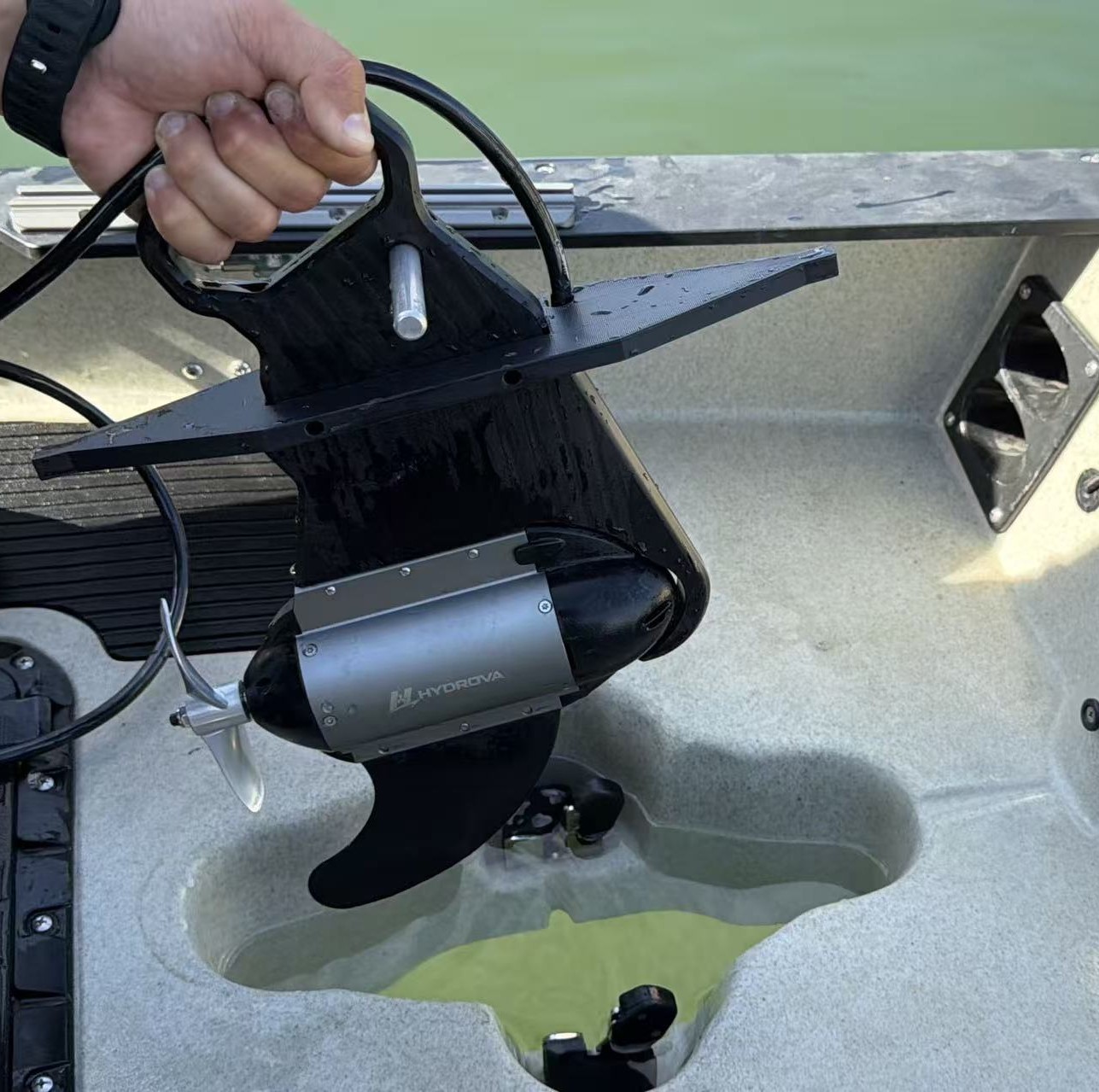
Hydrova YAK-1 Electric Kayak Motor
The Hydrova YAK-1 is a compact electric propulsion system designed for kayaks, SUPs, canoes, inflatables, and other lightweight watercraft.
Key features include:
- 24V electric platform
- 750W motor
- Up to 5 MPH on regular rigid kayaks
- Up to 5.5 MPH on lightweight inflatable kayaks
- Wireless remote control
- 4 forward speed levels
- 4 reverse speed levels
- Man-overboard detection
- Compact and portable design
- Multiple adaptor options
Electric Kayak Motor vs GPS Trolling Motor
A standard electric kayak motor and a GPS trolling motor serve slightly different purposes.
A compact electric kayak motor is mainly designed to provide portable propulsion.
A GPS trolling motor is designed for propulsion plus automated boat positioning.
GPS systems may include features such as:
- GPS position holding
- Heading control
- Remote steering
- Automatic course adjustment
Anglers who frequently fish offshore or in windy conditions may benefit from GPS position-holding technology.
Frequently Asked Questions
Is a kayak motor the same as a trolling motor?
Not always. A trolling motor is a type of electric marine motor, but dedicated kayak motors are often designed specifically around small watercraft, portability, compact batteries, and kayak mounting systems.
What size electric motor is good for a kayak?
The ideal motor depends on the kayak size, weight, hull design, water conditions, and intended use.
For many recreational and fishing kayaks, a motor in the approximately 500W to 1000W range can provide a useful balance between power and portability.
Is a 750W motor good for a kayak?
For many single-person kayaks, 750W can provide useful propulsion while keeping battery and motor size manageable.
How fast can a 750W kayak motor go?
The Hydrova YAK-1 can reach up to 5 MPH on regular rigid kayaks and up to 5.5 MPH on lightweight inflatable kayaks under suitable conditions.
Do I need GPS Spot-Lock for kayak fishing?
GPS position holding is not necessary for every angler, but it can be extremely useful when fishing in wind, current, or over specific underwater structure.
Final Thoughts
Both traditional trolling motors and dedicated electric kayak motors can work well on kayaks.
The main difference is how the system is designed and how easily it integrates with a small watercraft.
Traditional trolling motors can be simple and effective, while dedicated kayak motors can offer:
- Lower weight
- Better portability
- Kayak-specific mounting solutions
- Wireless control
- Compact batteries
For kayak anglers, the right motor should provide enough power without making the kayak unnecessarily heavy or difficult to transport.
The ideal setup combines:
Power + portability + range + control + compatibility.
Explore Hydrova Electric Kayak Motors
Portable electric propulsion designed for kayaks, SUPs, canoes, inflatables, and small boats.
Built for the way you fish.