How to Choose the Best Battery for an Electric Kayak Motor
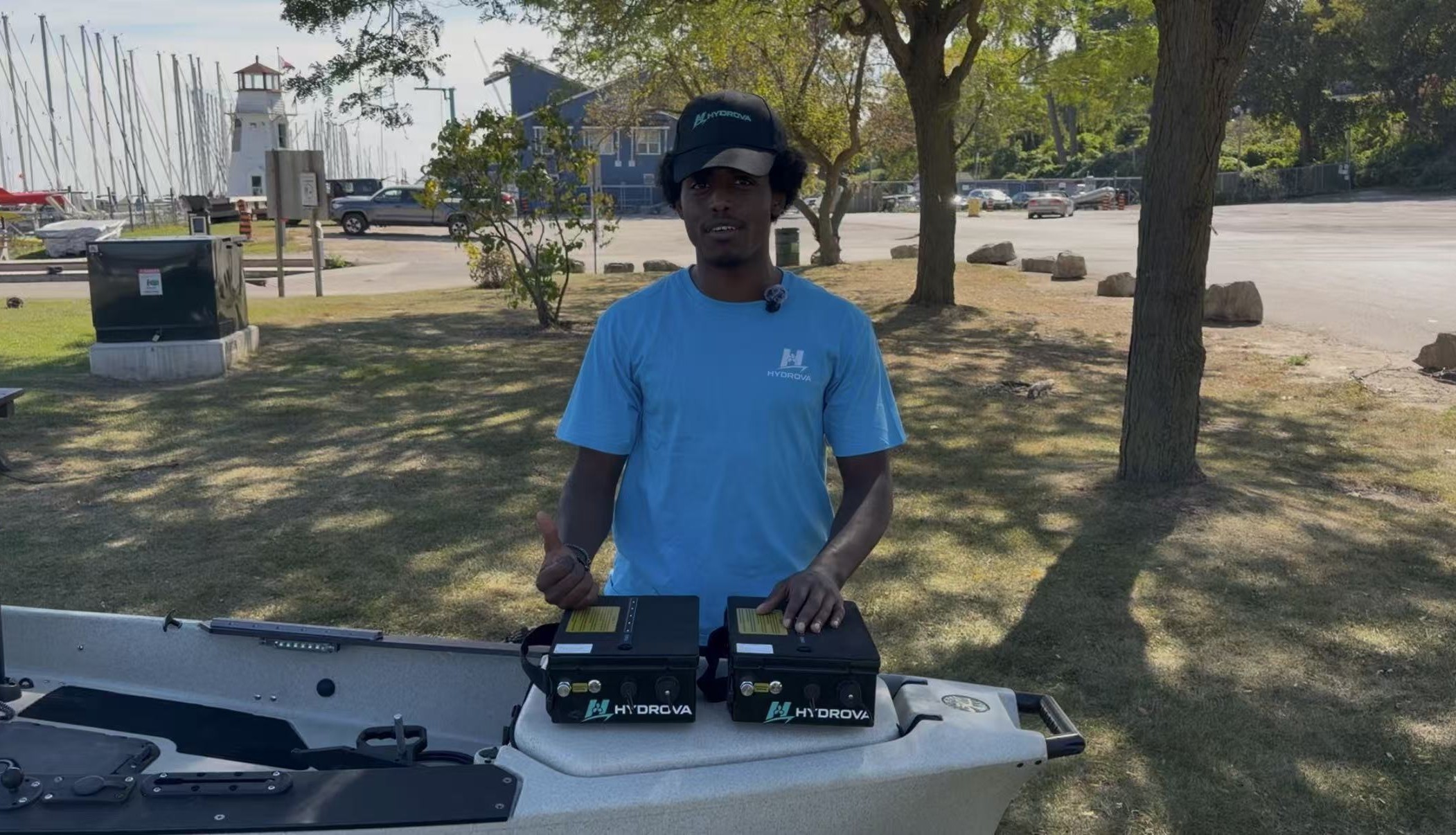
How to Choose the Best Battery for an Electric Kayak Motor
Choosing the right battery is just as important as choosing the right electric kayak motor.
A good battery should provide enough range for your trip without adding too much weight to the kayak.
The wrong battery can reduce performance, shorten runtime, or make the kayak unnecessarily heavy.
In this guide, we’ll explain how to choose the best battery for an electric kayak motor, including voltage, amp-hours, watt-hours, lithium battery advantages, runtime calculations, and safety considerations.
What Battery Does an Electric Kayak Motor Need?
The first thing to check is the motor voltage.
Common electric marine motor systems include:
- 12V
- 24V
- 36V
- Higher-voltage propulsion systems
The battery voltage must match the voltage required by the motor.
For example, the Hydrova YAK-1 uses a 24V electric platform, so it should be paired with a compatible 24V battery system.
Why Battery Voltage Matters
Voltage is one of the most important specifications when selecting a battery.
Using an incorrect battery voltage can prevent the motor from operating properly and may damage electrical components.
Always follow the motor manufacturer’s voltage requirements.
Understanding Amp-Hours
Battery capacity is often listed in amp-hours, usually written as Ah.
A larger Ah rating generally means the battery can provide energy for a longer period.
For example:
- 24V 20Ah battery
- 24V 32Ah battery
- 24V 50Ah battery
- 24V 58Ah battery
A 58Ah battery generally stores more energy than a 32Ah battery when both operate at the same voltage.
Understanding Watt-Hours
Watt-hours are often a better way to compare total battery energy.
Watt-hours can be calculated using:
Voltage × Amp-Hours = Watt-Hours
For example:
24V × 32Ah = 768Wh
A 24V 58Ah battery theoretically contains:
24V × 58Ah = 1,392Wh
Actual usable energy may be different depending on battery chemistry, BMS settings, voltage range, temperature, and discharge limits.
How Long Will a 24V 32Ah Battery Run a 750W Motor?
A simple theoretical runtime calculation can be made using watt-hours.
A 24V 32Ah battery has approximately:
768Wh
If a 750W motor continuously consumed 750W:
768Wh ÷ 750W = approximately 1.02 hours
This is a theoretical maximum-power calculation only.
Real-world runtime varies because motors do not always consume maximum power continuously.
At lower cruising speeds, runtime can be significantly longer.
Full Throttle vs Cruising Runtime
Maximum throttle uses battery energy much faster than moderate-speed cruising.
This is one of the most important things to understand when estimating kayak motor range.
A motor may be rated at 750W, but at lower speed settings it may consume substantially less power.
This means a battery that lasts around one hour at continuous maximum output could potentially provide several hours of operation during mixed-speed use.
Actual results depend on:
- Motor speed setting
- Kayak weight
- Wind
- Current
- Hull efficiency
- Propeller load
- Battery condition
What Size Battery Is Best for a Kayak Motor?
The ideal battery size depends on how you use your kayak.
Short Fishing Trips
For shorter trips close to the launch point, a smaller battery may provide enough range while keeping total weight low.
Benefits include:
- Lower weight
- Easier transport
- Faster installation
- Smaller footprint
All-Day Fishing
Anglers who spend many hours on the water may benefit from a larger-capacity battery.
A higher Ah rating can provide:
- Longer cruising time
- More reserve capacity
- More confidence on longer trips
- Less need to conserve power
Long-Distance Kayak Trips
For longer-distance travel, battery range should be prioritized over maximum speed.
A larger battery or dual-battery strategy may be useful for users traveling farther from the launch location.
Lithium vs Lead-Acid Battery for Kayak Motors
One of the biggest battery decisions is choosing between lithium and traditional lead-acid battery technology.
Lithium Battery
Lithium batteries are popular for kayaks because they can offer:
- Lower weight
- Higher usable capacity
- Long cycle life
- Stable voltage
- Compact size
- Faster charging options
Lower battery weight is especially valuable on a kayak, where total payload is limited.
Lead-Acid Battery
Traditional lead-acid batteries may have a lower purchase price, but they are generally much heavier for the same usable energy.
They may also provide less usable capacity before voltage drops significantly.
For portable kayak setups, weight is often the biggest disadvantage.
Why Lithium Batteries Are Popular for Kayaks
Every pound matters on a fishing kayak.
A lighter battery can improve:
- Transport
- Kayak balance
- Acceleration
- Payload capacity
- Ease of launching
This is one reason lithium battery systems have become common in modern electric kayak propulsion setups.
What Is a Battery Management System?
Most modern lithium batteries include a Battery Management System, often called a BMS.
The BMS helps protect the battery from conditions such as:
- Overcharging
- Over-discharging
- Excess current
- Short circuits
- High temperature
- Low temperature
When selecting a battery for a powerful motor, make sure the BMS can support the motor’s current requirements.
How Much Current Does a 750W Motor Need?
A basic current calculation is:
Current = Power ÷ Voltage
For a 750W motor operating at 24V:
750W ÷ 24V = approximately 31.25A
In practice, peak current may be higher during acceleration or under heavy load.
The battery and BMS should therefore be able to provide sufficient continuous and peak current.
Do Not Choose a Battery Based Only on Ah
Amp-hour capacity is important, but it is not the only specification that matters.
When choosing a kayak motor battery, check:
- Voltage
- Amp-hour capacity
- Watt-hour capacity
- Maximum continuous discharge current
- Peak discharge current
- BMS rating
- Battery weight
- Battery dimensions
- Water resistance
- Charging specifications
Battery Weight Matters
Kayaks have a limited payload capacity.
A heavier battery affects:
- Kayak balance
- Draft
- Acceleration
- Transport
- Launching
- Overall performance
The battery should provide enough range without adding unnecessary weight.
Where Should the Battery Be Installed?
Battery placement can affect kayak stability and handling.
In many setups, the battery should be positioned:
- Low in the kayak
- Securely mounted
- Protected from water
- Close to the kayak’s center of balance when possible
Avoid placing a heavy battery too far toward the bow or stern unless the kayak setup is designed for that weight distribution.
Should You Use a Waterproof Battery Box?
Protecting electrical connections from water is important on any small watercraft.
Depending on the battery design, a waterproof or water-resistant battery enclosure may provide additional protection.
Electrical connectors should also be protected against:
- Splashing
- Rain
- Corrosion
- Loose connections
How Far Can a Kayak Motor Go on One Battery?
Range depends on both runtime and speed.
For example, if your kayak travels at an average of 3 MPH for 5 hours:
3 MPH × 5 hours = 15 miles
This is only a simple example.
Actual range may be significantly different depending on:
- Throttle level
- Wind
- Current
- Water conditions
- Total kayak load
- Battery temperature
- Motor efficiency
Always Keep Battery Reserve
Never plan your trip around using 100% of the available battery capacity.
Conditions can change while you are on the water.
A headwind or stronger current on the return trip can significantly increase energy consumption.
Keeping battery capacity in reserve provides an important safety margin.
Can a Bigger Battery Make Your Kayak Faster?
Usually, no.
If two batteries provide the same voltage and both can supply enough current, the larger-capacity battery will normally increase runtime rather than top speed.
For example:
- A 24V 32Ah battery
- A 24V 58Ah battery
can both operate the same 24V motor, assuming both batteries meet the required current specifications.
The 58Ah battery should primarily provide more stored energy and longer operating time.
Should You Carry a Spare Battery?
A spare battery can be useful for anglers who travel long distances or spend a full day on the water.
Advantages include:
- Additional range
- Emergency backup
- Flexibility for longer trips
However, a second battery also adds weight, so make sure the kayak remains within its safe payload capacity.
Charging Your Kayak Motor Battery
Always use a charger designed for the battery chemistry and voltage.
A lithium battery should be charged using a compatible lithium charger.
Before charging:
- Inspect connectors
- Keep the charger dry
- Check the battery for damage
- Follow the battery manufacturer’s charging instructions
Battery Storage
Proper storage can help extend battery life.
General considerations include:
- Store the battery in a dry location
- Avoid extreme heat
- Avoid physical damage
- Use the correct storage charge level recommended by the battery manufacturer
- Inspect cables and connectors regularly
Best Battery Size for the Hydrova YAK-1
The Hydrova YAK-1 operates on a 24V 750W platform.
Battery selection should depend on how long you plan to operate the motor and how important portability is to your setup.
Standard Battery Option
A compact 24V 32Ah battery can provide a good balance between:
- Weight
- Portability
- Range
- Battery size
Long-Range Battery Option
For anglers who want longer operating time, a larger 24V 58Ah battery can provide significantly more stored energy.
The trade-off is additional battery size and weight.
Hydrova YAK-1 Performance
The Hydrova YAK-1 is designed as a compact electric propulsion system for kayaks, SUPs, inflatables, canoes, and small boats.
Key specifications include:
- 24V electric system
- 750W motor
- Up to 5 MPH on regular rigid kayaks
- Up to 5.5 MPH on lightweight inflatable kayaks
- Wireless remote control
- 4 forward speed levels
- 4 reverse speed levels
- Man-overboard detection
- Multiple mounting adaptor options
Frequently Asked Questions
What battery do I need for a 750W kayak motor?
The required battery depends on the motor voltage. For a 24V 750W system such as the Hydrova YAK-1, use a compatible 24V battery that can provide sufficient continuous and peak current.
How many Ah do I need for a kayak motor?
It depends on your desired runtime. A smaller Ah battery is lighter and easier to transport, while a higher-capacity battery generally provides longer operating time.
Is a 32Ah battery enough for a kayak motor?
A 24V 32Ah battery can provide a useful balance between portability and runtime for many recreational fishing trips, depending on speed setting and water conditions.
Does a 58Ah battery last longer than a 32Ah battery?
Yes. At the same voltage and under similar operating conditions, a 58Ah battery stores more energy and should provide longer runtime than a 32Ah battery.
Is lithium better than lead-acid for a kayak?
Lithium batteries are often preferred for kayaks because they can offer lower weight, higher usable energy, stable voltage, and longer cycle life.
Can I use a car battery for a trolling motor?
A starting battery is generally designed for short bursts of high current rather than repeated deep discharge. Marine deep-cycle or suitable lithium batteries are generally more appropriate for electric propulsion applications.
Does a larger battery increase motor speed?
Usually not. If voltage remains the same, increased battery capacity mainly increases runtime rather than maximum motor speed.
Final Thoughts
The best battery for an electric kayak motor is one that provides enough range without adding unnecessary weight.
When comparing batteries, look beyond amp-hours.
Consider:
- Correct voltage
- Watt-hour capacity
- Continuous discharge current
- BMS rating
- Battery weight
- Battery size
- Water resistance
- Charging requirements
For a portable kayak motor setup, the goal is to balance:
Range + weight + power delivery + reliability + portability.
A properly matched battery can help you travel farther, spend more time fishing, and get better performance from your electric kayak motor.
Power Your Next Trip with Hydrova
Portable 24V electric propulsion designed for kayaks, SUPs, canoes, inflatables, and small boats.
Go Further. Fish Smarter.