Best Trolling Motor for Kayak Fishing in 2026
Best Trolling Motor for Kayak Fishing in 2026: What Should You Look For?
Choosing the best trolling motor for kayak fishing can make a major difference in how far you travel, how easily you control your kayak, and how much time you can spend actually fishing.
Modern kayak motors are becoming lighter, more efficient, and more advanced. Anglers can now choose between compact electric propulsion motors, traditional trolling motors, and GPS-enabled systems with position-holding features.
But which type of motor is right for your kayak?
In this guide, we’ll explain the most important features to consider when choosing a kayak trolling motor in 2026, including power, speed, battery life, mounting options, wireless control, GPS features, and portability.
What Makes a Good Trolling Motor for a Kayak?
The best kayak trolling motor is not necessarily the most powerful motor available.
Kayaks have limited space and weight capacity, so a good system should balance:
- Power
- Weight
- Battery consumption
- Speed
- Mounting compatibility
- Ease of control
- Portability
- Safety
For many kayak anglers, a lightweight motor with good control and sufficient range is more useful than an oversized motor designed for a larger boat.
1. Choose the Right Motor Power
Motor power is one of the first specifications buyers compare.
Traditional trolling motors are commonly rated in pounds of thrust, while newer electric kayak motors may be rated in watts.
For many single-person fishing kayaks, approximately 500W to 1000W can provide a practical balance between performance and portability.
More power can help with:
- Heavier kayaks
- Extra fishing equipment
- Wind
- Current
- Longer-distance travel
However, more power can also require a larger battery and stronger mounting system.
2. Consider Real-World Speed
Maximum speed is important, but it should not be the only factor you consider.
Kayak hull shape has a large effect on speed.
Wide fishing kayaks are designed for stability, while narrower hulls may move more efficiently through the water.
The Hydrova YAK-1 750W electric kayak motor, for example, can reach:
- Up to 5 MPH on regular rigid kayaks
- Up to 5.5 MPH on lightweight inflatable kayaks
Actual speed depends on total load, hull design, wind, current, battery condition, propeller efficiency, and mounting setup.
3. Battery Range Matters More Than Maximum Speed
A fast motor is not very useful if the battery runs out before you finish fishing.
Battery range should be one of the most important considerations when choosing a trolling motor for a kayak.
Battery capacity is normally measured in:
- Amp-hours (Ah)
- Watt-hours (Wh)
For example, a 24V 32Ah battery has a theoretical energy capacity of:
24V × 32Ah = 768Wh
Running at full power will use energy much faster than cruising at moderate speed.
For many anglers, efficient cruising is more important than continuously operating at maximum throttle.
4. Weight Is Extremely Important
Unlike a large fishing boat, a kayak has limited payload capacity.
Every component adds weight:
- Motor
- Battery
- Mounting bracket
- Fish finder
- Fishing gear
- Cooler
- Anchoring equipment
A heavy motor and battery system can make the kayak harder to launch, transport, and control.
This is why compact electric propulsion systems are increasingly popular with kayak anglers.
5. Choose the Right Mounting System
Mounting compatibility is one of the most important factors when choosing a kayak trolling motor.
Different kayaks have very different layouts.
Pedal Drive Mount
Pedal-drive kayaks may allow a motor to be installed through the existing pedal drive opening.
This can provide a compact and centrally located installation.
Rudder Mount
Some kayaks can use the existing rudder mounting location for an electric motor or motor adaptor.
Stern or Transom Mount
Installing a motor at the rear of the kayak is one of the most common motor configurations.
This can be simple and effective when the kayak has a suitable mounting area.
Bow Mount
Bow-mounted trolling motors are increasingly popular among serious kayak anglers.
They are especially useful when paired with GPS position-holding technology.
SUP Mount
Electric motors can also be installed on compatible stand-up paddle boards using dedicated SUP mounting adaptors.
6. Wireless Remote Control
Wireless control can be very useful on a kayak.
Traditional trolling motors often use a tiller handle, but reaching a rear-mounted tiller can be uncomfortable or inconvenient from a seated position.
A wireless remote allows the angler to operate the motor while remaining in the normal fishing position.
Depending on the motor system, wireless control may include:
- Power control
- Forward speed
- Reverse speed
- Steering
- Emergency stop
- GPS functions
7. Forward and Reverse Control
Reverse is extremely useful when fishing from a kayak.
It can help when:
- Backing away from shore
- Leaving a dock
- Adjusting your fishing position
- Moving around structure
- Recovering from tight areas
Multiple forward and reverse speed settings provide better low-speed control.
The Hydrova YAK-1 provides:
- 4 forward speed levels
- 4 reverse speed levels
8. GPS Spot-Lock for Kayak Fishing
GPS position holding is one of the biggest upgrades available for modern kayak fishing.
A GPS trolling motor can automatically make steering and power adjustments to help keep the kayak near a selected location.
This is especially useful when fishing:
- Offshore structure
- Drop-offs
- Rock piles
- Weed lines
- River current
- Windy open water
Instead of constantly correcting the kayak position manually, the angler can spend more time casting and fishing.
Do You Need Spot-Lock on a Kayak?
Not every kayak angler needs GPS position holding.
If you mainly fish calm ponds, small lakes, or protected areas, a simple electric propulsion motor may be enough.
GPS position holding becomes more valuable when you regularly fish:
- Large lakes
- Open water
- Strong current
- Windy conditions
- Specific underwater structure
9. Safety Features
Safety should always be considered when using a powered kayak.
Useful motor safety features may include:
- Kill switch
- Man-overboard detection
- Wireless emergency stop
- Low-voltage protection
- Over-current protection
If an angler falls into the water, a motor should not continue driving the kayak away.
The Hydrova YAK-1 includes a wireless man-overboard detection function designed to stop propulsion if the operator becomes separated from the control device.
10. Portability
Kayak fishing often involves transporting equipment from your vehicle to the launch area.
A good kayak motor should therefore be easy to:
- Carry
- Install
- Remove
- Store
- Transport
This is especially important for anglers who do not keep their kayak permanently rigged on a trailer.
Best Type of Trolling Motor for Different Kayak Anglers
Best for Casual Fishing
Casual anglers may prefer:
- Compact motor
- Simple wireless controls
- Moderate power
- Easy installation
- Lightweight battery
GPS features may not be necessary if you mainly fish calm and protected water.
Best for Long-Distance Fishing
Anglers who travel farther should prioritize:
- Efficient cruising
- High battery capacity
- Low motor weight
- Reliable remote control
- Easy battery replacement
Best for Offshore Structure Fishing
GPS trolling motors can be especially useful for anglers targeting offshore structure.
Useful features include:
- GPS position holding
- Remote steering
- Heading control
- Automatic position correction
Best for Portable Kayak Setups
Anglers who frequently move their kayak between different lakes and launch locations should look for:
- Compact motor design
- Quick-release installation
- Lightweight battery
- Multiple mounting adaptor options
Traditional Trolling Motor vs Dedicated Kayak Motor
| Feature | Dedicated Kayak Motor | Traditional Trolling Motor |
|---|---|---|
| Size | Compact | Usually larger |
| Weight | Typically lower | Varies |
| Mounting | Multiple kayak-specific options | Mainly transom or bow mount |
| Control | Wireless control common | Tiller, foot pedal, or remote |
| Battery | Compact lithium systems common | Traditional marine batteries common |
| Portability | High | Depends on model |
How Much Power Does a Fishing Kayak Need?
There is no single power level that works for every kayak.
Consider:
- Kayak length
- Kayak width
- Hull shape
- Total loaded weight
- Typical water conditions
- Wind
- Current
For many single-person fishing kayaks, approximately 500W to 1000W can provide useful performance without requiring an excessively large propulsion system.
How Fast Should a Kayak Trolling Motor Be?
Most kayak anglers do not need extremely high speeds.
A motor that can move a fishing kayak around 4 to 5 MPH can dramatically reduce travel time compared with paddling.
Speed becomes especially useful when:
- Moving between fishing spots
- Crossing large bays
- Returning to the launch
- Covering larger lakes
Once you reach the fishing area, low-speed control may become more important than top speed.
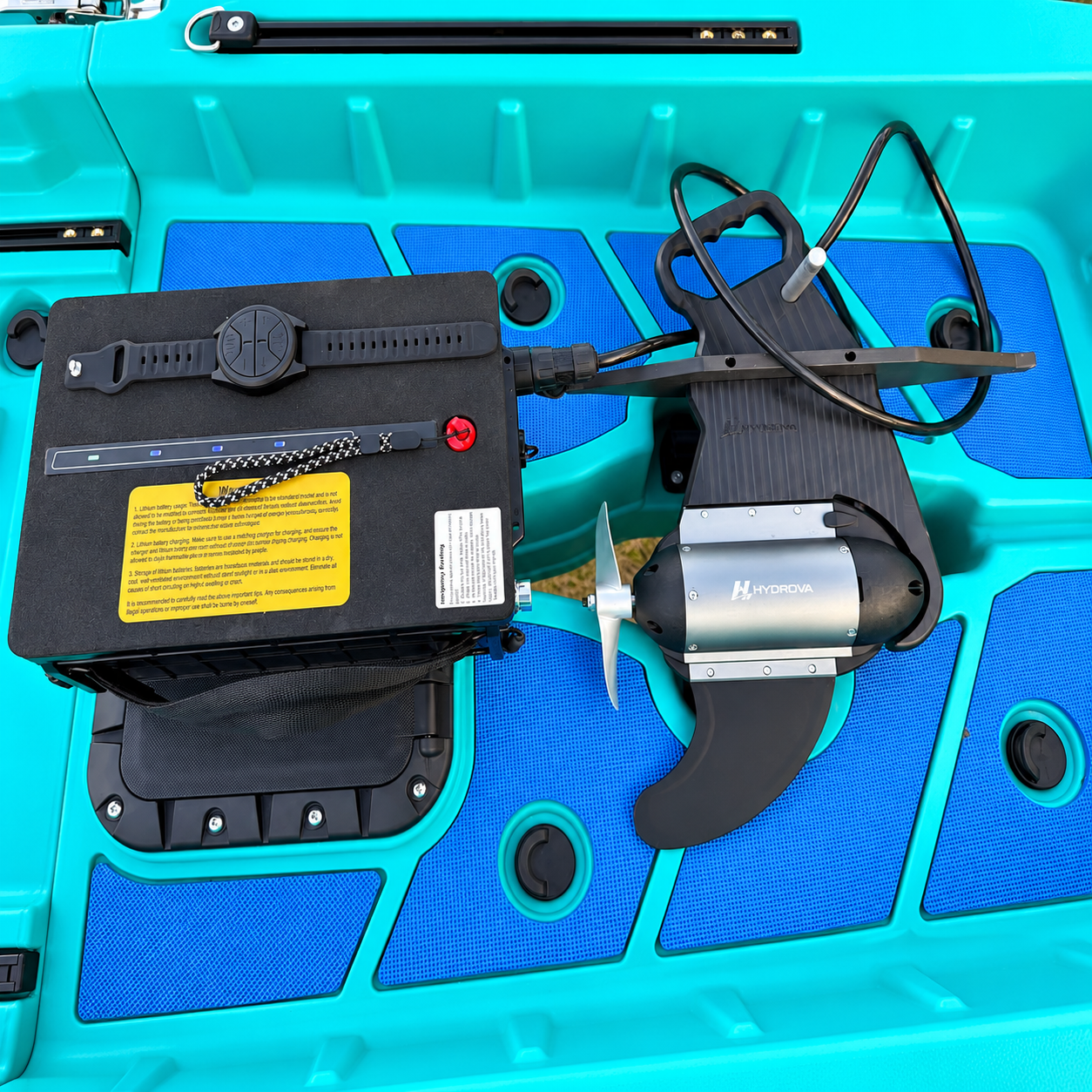
Hydrova YAK-1: Portable Electric Propulsion for Kayak Fishing
The Hydrova YAK-1 is designed for anglers who want a compact and portable electric motor that can work with multiple types of small watercraft.
Key features include:
- 24V electric platform
- 750W motor
- Up to 5 MPH on regular rigid kayaks
- Up to 5.5 MPH on lightweight inflatable kayaks
- Wireless remote control
- 4 forward speed levels
- 4 reverse speed levels
- Man-overboard detection
- Portable design
- Multiple mounting adaptor options
Depending on the kayak, mounting options can include:
- Pedal drive adaptor
- Rudder fin adaptor
- SUP adaptor
- Stern mounting solutions
What About a GPS Spot-Lock Trolling Motor?
Anglers who want more advanced boat positioning can consider a GPS-enabled trolling motor.
A GPS trolling motor is particularly useful when your priority is holding the kayak in one location while fishing.
These systems can be useful for:
- Open-water fishing
- Bottom fishing
- Fishing offshore structure
- Holding position against wind
- Holding position against current
Hydrova also offers GPS-oriented trolling motor solutions for anglers who want more advanced positioning and remote control.
What Battery Should You Use?
Lithium batteries are popular for kayak propulsion because they can offer high energy capacity at a lower weight than many traditional lead-acid batteries.
When selecting a battery, check:
- Correct voltage
- Amp-hour capacity
- Maximum continuous current
- BMS specifications
- Weight
- Water resistance
- Charging requirements
A larger battery generally increases runtime rather than maximum speed, assuming the voltage remains the same.
Can You Put a Trolling Motor on Any Kayak?
Not every kayak is designed for a motor.
Before installing one, check:
- Weight capacity
- Mounting strength
- Battery placement
- Motor clearance
- Propeller clearance
- Steering system
- Local boating regulations
Some kayaks may require a model-specific adaptor or custom mounting solution.
Frequently Asked Questions
What is the best size trolling motor for a fishing kayak?
The correct size depends on kayak weight, hull design, water conditions, and intended use. For many single-person kayaks, a compact motor in the approximately 500W to 1000W range can provide useful performance.
Is a 750W motor enough for kayak fishing?
For many fishing kayaks, 750W can provide a strong balance between usable power, portability, battery size, and speed.
How fast can a 750W kayak motor go?
The Hydrova YAK-1 can reach up to 5 MPH on regular rigid kayaks and up to 5.5 MPH on lightweight inflatable kayaks under suitable conditions.
Is GPS Spot-Lock worth it on a kayak?
It can be especially useful for anglers who regularly fish in wind, current, or over specific offshore structure.
Is a bow mount or stern mount better?
Both can work well. Stern mounting is often simpler and more compact, while bow mounting can be advantageous for advanced GPS trolling motors and automatic positioning.
Can I use a trolling motor on an inflatable kayak?
Yes, if the inflatable kayak has a compatible and properly reinforced motor mounting system.
Final Thoughts
The best trolling motor for kayak fishing in 2026 should match the way you actually use your kayak.
Rather than choosing based only on maximum power, consider:
- Motor weight
- Battery capacity
- Range
- Mounting compatibility
- Forward and reverse control
- Wireless operation
- Safety features
- GPS functionality
For portable fishing setups, a compact electric motor can provide an excellent combination of range, speed, and convenience.
For anglers who need automatic positioning in wind or current, a GPS-enabled trolling motor may provide additional control.
The ideal kayak motor should help you:
Travel farther. Control your kayak more easily. Spend more time fishing.
Explore Hydrova Kayak Motors
Electric propulsion and GPS trolling motor solutions designed for kayaks, SUPs, inflatables, canoes, and small boats.
Go Further. Fish Smarter.